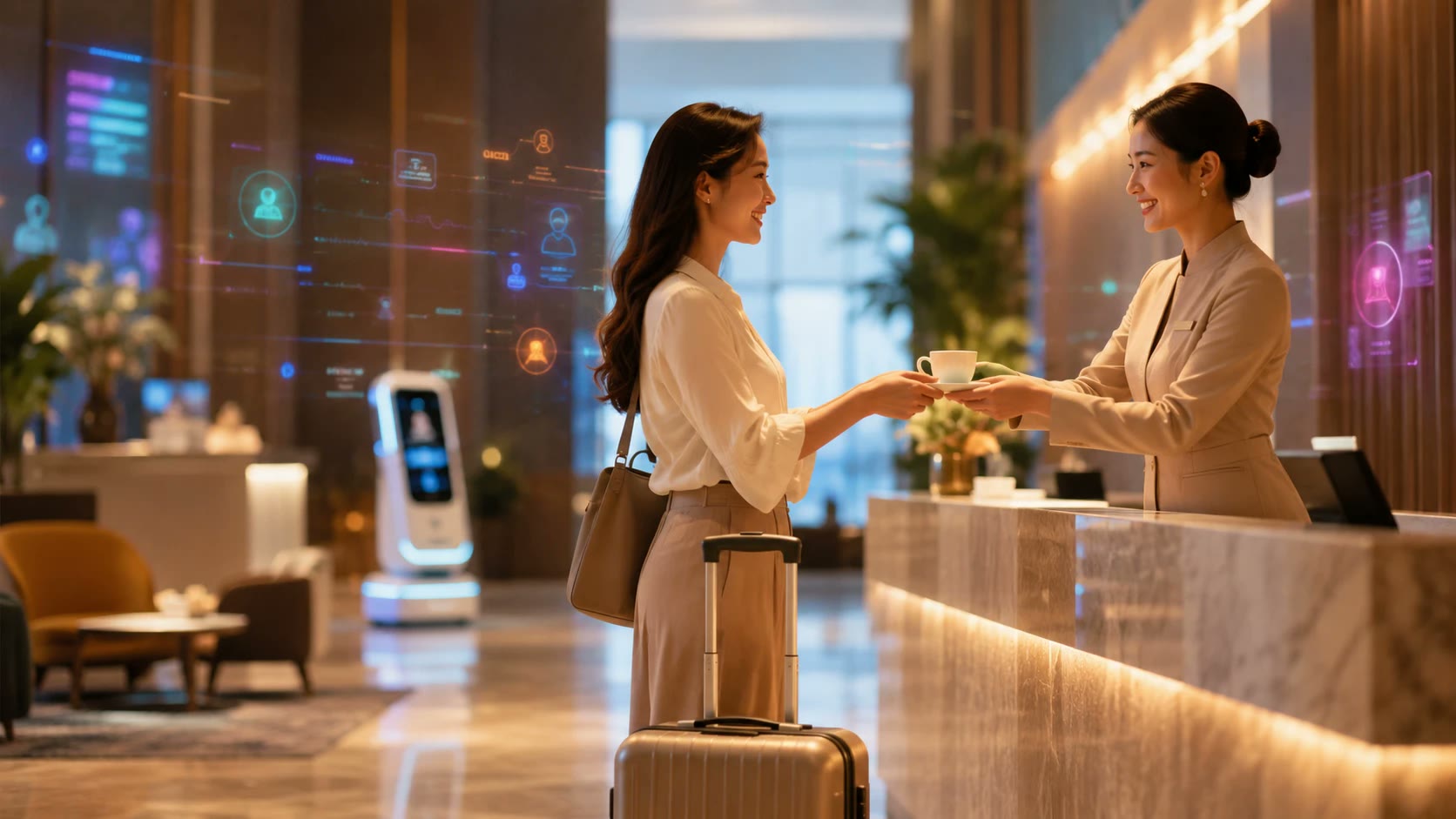
The more a hotel automates, the more its humanity is worth. Let's discover why this is so…
I want you to think about the following technologies that did not exist a while ago:
- Elevator
- Magnetic card as a room key
- Property Management System
- WiFi for Internet
- Buggy
Now all of them are taken as granted. They are hygiene factors, which means they are “must to have” for all hotels even they did not exist 50 years ago.
Let's now imagine that a guest walks into two hotels next year and they may not be able to tell the technology apart. The same AI concierge, the same instant translation, the same predictive housekeeping. Of course not all of them will have the same quality but our discussion is not about this.
The main idea is that the software will be seen to exist everywhere. Then what is left for the hotel to compete?
We assert that the more a hotel automates, the more its humanity matters, not less. This isn't nostalgia, and it isn't a plea to keep humans around out of sentiment. It's a competitive argument. As technology converges toward a shared, excellent baseline, the human layer stops being the soft part of the business and becomes the only part that can still set you apart.
Technology raises the floor
Good technology lifts the minimum a guest can expect and then disappears into the background. A decade ago, mobile check-in or real-time multilingual messaging was a differentiator. Soon it will be table stakes, the way Wi-Fi went from amenity to assumption. That is exactly what we want it to do: make the baseline of a stay reliable, fast, and frictionless.
But a rising floor wins you nothing on its own. When every hotel clears the same bar, the bar stops being a differentiator. Nobody books a second stay because the friction was absent; they book it because something was present.
Technology raises the floor. Only people raise the ceiling.
Humanity raises the ceiling
The ceiling is where preference, premium, and memory actually live and none of them are produced by efficiency. They're produced by a person who notices, who adapts, who does something a little more generous than the process required.
Two hotels can run identical systems and deliver completely different stays, and the gap between them is entirely human. It helps to see the whole field at once. Plot a hotel on two axes (1) how much technology it runs, and (2) how much genuine human touch it offers. The following four very different businesses appear:
High touch · Low tech
Warm, but it doesn't scale
High touch · High tech
Amplified hospitality. The goal.
Low touch · Low tech
A commodity
Low touch · High tech
Efficient and forgettable. The trap.
More technology, left to right. More human touch, bottom to top.
Automation alone marches you rightward — more efficient, more consistent — but it can't move you upward. Pour everything into technology while treating people as the line item to trim, and you land in the bottom-right: a hotel that runs beautifully and is remembered by no one. The goal is the top-right, and you only get there by investing in both.
Human attention is becoming the scarce luxury
There's a deeper reason humanity is appreciating in value: it's getting rare. We move through more of our lives via screens and systems than ever — ordering, booking, checking in, checking out, often without speaking to a single person. In that world, genuine human attention stops being ordinary and starts being a kind of luxury. A hotel that offers it is offering something the rest of a guest's day no longer does.
The pattern is consistent across industries: as the routine gets automated, the relational gets precious.
In one of our customer hotels, the hotel staff are trained to be so sincerely friendly that most of them become closer to the hotel guests and even the hotel allocated a budget for the hotel staff if they want to welcome their guests at their home (e.g. for a tea and cookie session with a great chat). This is not something that is deliberately planned but the hotel makes their staff happy, the staff does not look for any other job in any other hotels, they are satisfied and this reflects to the guests naturally. The guests are already loyal guests, even most of them are from other countries, they are so satisfied with the sincere service that they became friends with the hotel staff. That is a great example of human touch.
What "more humanity" actually means
“More humanity” is easy to say and easy to flatten into a slogan. It does not mean a warmer mission statement or a line about “putting people first” on the careers page. In practice it means four harder, more concrete commitments:
Spend the freed time on purpose. When AI lifts an hour of friction off a shift, that hour is the asset. Direct it deliberately toward guests — or it quietly leaks back into busywork.
Hire and train for the human skills. Empathy, judgment, and service recovery are the durable, high-value abilities now — not speed at a screen the software has already taken over.
Give frontline staff the authority to act. A human moment dies the instant an employee has to say “let me check with my manager.” Empowerment is what turns good intentions into memorable gestures.
Invest in the culture behind the desk. Guests can feel whether the people serving them are themselves cared for. The warmth a guest receives is rarely greater than the warmth the team is given.
Each of these is an investment, not a cost. Each runs directly against the instinct the AI wave tends to trigger, which is to use automation as a reason to spend less on people. That instinct is the trap. Cut the humans to fund the technology and you optimize your way into the forgettable quadrant.
The other half of the framework
In Part 1, we argued that AI should amplify human capability rather than replace it. The machine's job is to clear the path so a person can create the moment. This is the other half of that argument. If humanity is the thing being amplified, then humanity is the thing worth investing in. Amplifying a team you've hollowed out amplifies nothing.
So the Human Amplification Framework isn't only a claim about what AI should do. It's a claim about where hotels should put their money and their attention: into the one layer technology can't reach.
More human, on purpose
The future of hospitality isn't less human. It's more human by design. The hotels that understand this will let the machines handle everything that was never the point, and pour everything they save back into the people who are.
When every hotel can buy the same intelligence, humanity is the only thing left to compete on. Spend accordingly.
Next · Part 3
How to Measure Whether AI Is Improving the Guest Experience
Continue reading